2025, Reefscape
2025 robot
An elevator, pivot and wrist arm that scores coral on the reef, where graph search keeps the joints from colliding and an auto picks its own next target.
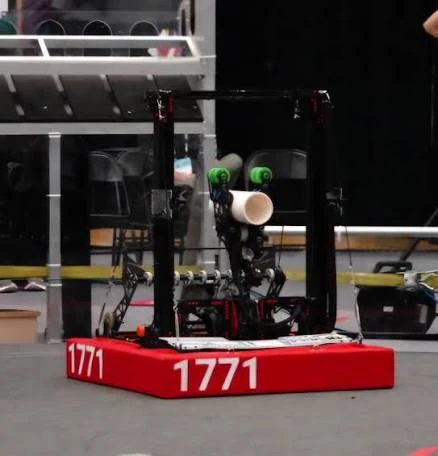
The game and the robot
REEFSCAPE asked robots to score coral on the reef, handle algae, and climb at the end of the match. Our robot stacked an elevator, a pivot and a wrist on one arm, and drove on a swerve base with PhotonVision cameras for field position. The code was written by the programming team of Team 1771. Here is what I learned from it.
Graph search: keeping three joints from colliding
The elevator, pivot and wrist can hit each other or the frame if they move in the wrong order. We modelled the arm as a graph where every node is a safe pose of all three joints and the only legal moves are the links between poses. A breadth-first search finds the shortest safe route from the current pose to the requested one. The skill was recognising a mechanical safety problem as a shortest-path problem on a graph.
Planning on the fly: an auto with no path files
The 2025 autonomous routine is not a list of drawn paths. One auto keeps asking an objective tracker for the next reef target, drives there, scores, and asks again, so it adapts when a target is already taken. The drive-to-pose controller is built on an open-source autopilot library, not something we wrote from scratch. The skill was designing around decisions made live, with coordinates and geometry, instead of a fixed script.
Working as a team
Dashboard layouts are kept alongside the code and the team follows a written style guide for naming, so a new programmer can find their way around the whole robot.