2026, Rebuilt
2026 robot
A turret shooter built on number theory, measured data and statistics: it finds its angle at power-on with the Chinese Remainder Theorem and is tested in simulation before it touches the field.
The game and the robot
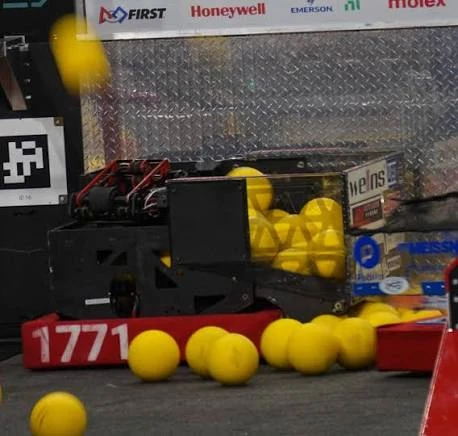
REBUILT asks robots to collect fuel, shoot it into the goal, and keep scoring as the advantage shifts between the alliances. Our robot picks fuel up with an intake, feeds it through a spindexer, and shoots it from a turret with an adjustable hood and two shooter wheels. The software is written by the programming team of Team 1771, and most of what I learned on it was math and problem solving, so that is what this page covers.
Number theory: knowing the turret angle at power-on
The turret needs to know which way it points the moment the robot turns on. It carries two absolute encoders on gears with different tooth counts. Each encoder alone only gives its angle within one turn of its own gear, which is ambiguous. Together the two readings fit exactly one turret angle, and the Chinese Remainder Theorem is the math that finds it. The skill was turning a modular arithmetic idea from number theory into a few lines of working robot software.
Data and interpolation: distance to shooter speed
Instead of deriving the physics of a flying fuel ball, we measured it. We shot from a spread of distances, recorded the shooter speed that scored at each, and kept the pairs in a table. The robot looks up its distance to the goal and interpolates between the two nearest rows. This is a distance to shooter speed table, and the lesson was choosing a simple, testable model over a complicated one that is harder to trust.
Statistics: vision trust fitted offline
Cameras estimate where the robot is, and each estimate carries a standard deviation that says how far to trust it. Guessing those numbers makes the pose jump. Instead we logged real vision data in practice and fitted the trust model offline with Python scripts. That took statistics, working with real data, and checking a model against measurements.
Simulation: FuelSim
FuelSim is an open-source projectile simulator that we used to model every fuel ball from the shooter wheels to the goal. Using it meant understanding the projectile physics well enough to set it up and to tell whether its answers made sense, so a bad shot setting fails on a laptop instead of in the pit.
Graph thinking: superstate graph and objective-driven autos
Two ideas from our 2025 robot carry over. The superstate graph treats the robot as a set of safe poses and only allows moves between neighbours, so mechanisms never fight each other. Objective-driven autos are written as code instead of drawn paths: each auto is a list of objectives such as collect fuel at a spot or shoot from a spot, and a drive-to-pose controller takes the robot to each in turn. Both are graph and geometry problems more than robotics ones.
After the season
Once the season ended we rewrote the robot software in Java on top of AdvantageKit, with a real, a simulated and a replay layer for every mechanism, so the same code runs on the robot, in simulation and against a recorded log.